
Maths
Maths can look like this.......
Mathematics- ‘do it, twist it, deepen it’
We deliver our Maths curriculum through a teaching for Mastery approach. As a staff team, we have attended and been a part of the on-going teaching for Mastery CPD provided by the Central Maths Hub. This has included specific training for 'Mastering Number', which is used in all year groups to improve mathematical fluency.
We chose Maths Mastery as an approach because each session equips children with the skills of fluency, reasoning and problem solving that they need in life beyond school. Opportunities for deepening understanding are built into the curriculum, with challenge for rapid graspers, and scaffolds to support struggling learners. Conceptual understanding is taught in tandem with procedural fluency in order to embed mathematical thinking. Children then apply their understanding through real-life problem-solving activities. Progression is planned for and key skills revisited regularly.
/424CEB39A94DB23B6115903E1ABCBD20.jpg)
We believe that the Essential Characteristics of Mathematicians include:
- An understanding of the important concepts and the ability to make connections within mathematics.
- A broad range of skills in using and applying mathematics.
- Fluent knowledge and recall of number facts.
- To demonstrate initiative in solving problems within a wide range of contexts, including the new or the unusual.
- The ability to think independently and to persevere when faced with challenges, showing a confidence of success.
- To be able to embrace the value of learning from mistakes and false starts.
- To reason, generalise and make sense of solutions.
- Fluency in performing written and mental calculations and mathematical techniques.
- Use a wide range of mathematical vocabulary.
- A commitment to the passion for the subject.
IMPLEMENTATION
Maths is taught daily and lessons are taught discretely through a mastery approach. We believe that the three aims of the National Curriculum should be addressed every day, Fluency, Reasoning and Problem Solving.
Lessons begin with a problem, instead of ‘Let me teach you …’ as a starting point, children are encouraged to explore the problem themselves. This is referred to as the ‘anchor task’. Children then have opportunities to practically explore their learning and use whiteboards or jotters to record their thinking. This takes place during the guided practice part of the session. When appropriate, children begin their independent practice and explore the new knowledge within a variety of concepts.
Although this might look a little different in Early Years, children are still encouraged to explore problems through an ‘anchor task’ and this is then reinforced through the indoor/outdoor environment and enhancements.
Within Key Stage 1, lessons are designed for fluid groups, scaffolding is provided by way of support, concrete apparatus and links to previous learning. There is also an expectation that all children can achieve depth at some point within the lesson. Additional adults within the class support children to access learning through small group intervention and guided input to increase focus and engagement.
We access the White Rose Curriculum to inform our long-term overview and planning for Maths. We use the appropriate and progressive representations as outlined within our calculation policy. We recognise that a lack of fluency skills can be detrimental to the progress children make when accessing problem-solving activities. To address this we build in Retrieval Practice on a daily basis to ensure fluency skills are revisited and embedded and links to previous learning built upon.
The key elements of teaching for mastery can be found HERE
Longitudinal Learning in Maths
The longitudinal learning in Maths is designed to help pupils to revisit ideas and concepts in a variety of situations and to slowly develop an understanding over time. We encourage pupils to repeat the curriculum as many times as possible, in as many different ways as possible, so that they develop a gradual and developmental understanding of knowledge, skills and behaviours.
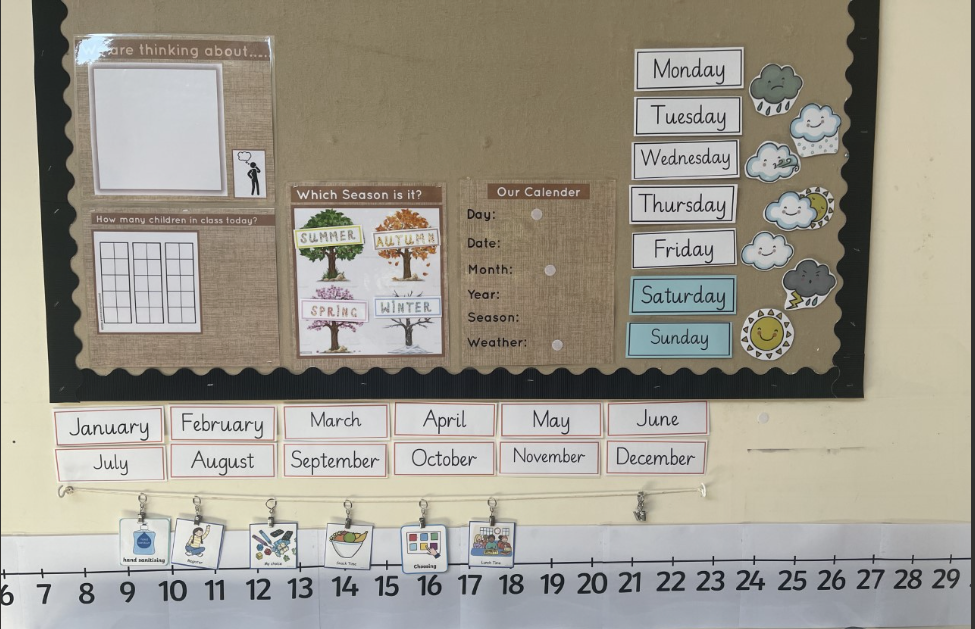
/E341263B2B41FC3B38390F28C212C11B.jpg)
Maths in the Early Years
/6CBBD25F2B9745821DF36908E4D17083.jpg)
There are six main areas that collectively underpin children’s early mathematical learning, and which provide the firm foundations for the maths that children will encounter as they go up the years in primary school.
They are:
- Cardinality and Counting: understanding that the cardinal value of a number refers to the quantity, or ‘howmanyness’ of things it represents.
Click HERE - Comparison: understanding that comparing numbers involves knowing which numbers are worth more or less than each other.
Click HERE - Composition: understanding that one number can be made up from (composed from) two or more smaller numbers.
Click HERE - Pattern: looking for and finding patterns helps children notice and understand mathematical relationships
Click HERE - Shape and Space: understanding what happens when shapes move, or combine with other shapes, helps develop wider mathematical thinking
Click HERE - Measures: comparing different aspects such as length, weight and volume, as a preliminary to using units to compare later.
Click HERE